

AI Agents and Startup Analytics: How Artificial Intelligence Is Transforming Startup Decision-Making

.avif)

“We registered the company first and later realized a startup is not just about the registration.”
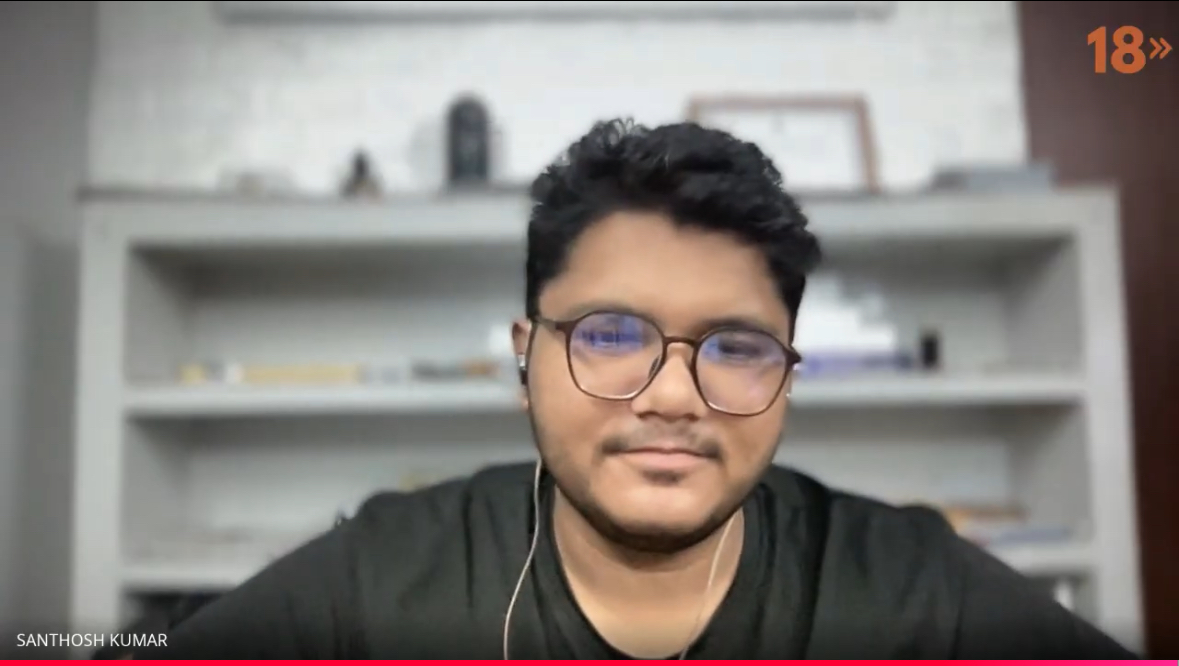
That’s how Santosh looks back at the beginning of his startup journey. Not with regret, but with clarity.
Today he laughs at those early mistakes. To him, they were never failures. They were simply the starting points of a three-and-a-half-year exploration of what building a startup actually means.
So who is Santosh?
Santosh started his entrepreneurial journey during the second year of his undergraduate studies at Rajalakshmi Institute of Technology in Chennai. Like many engineering students, he and his co-founder were deeply fascinated by AI and emerging technologies. They spent hours discussing technology, where the world was heading, and what they could build.
One day that conversation turned into a simple question:
Should we really wait for placements?
Or should we try building something ourselves?
That question led to their first big decision.
They registered a company.
At the time, it felt like the logical first step. But very quickly they realized something important. Registering a company does not mean you have a startup. It simply means you have a company on paper.
A real startup needs:
• A problem worth solving
• A product
• Validation from users
• And eventually, revenue
Still, that early decision created something extremely valuable: commitment.
Once the company existed on paper, the journey suddenly felt real. They were no longer students casually discussing ideas. They were now responsible for building something.
And that responsibility pushed them forward.
In the early days, Santosh and his team started as an AI-focused startup without being tied to any specific industry. They experimented across multiple domains- robotics, agriculture, finance, and healthcare.
First, they explored robotics by attempting to build an AI-powered rover. But the project required heavy investment, something unrealistic for two college founders.
So that idea had to be dropped.
Then they explored agriculture and finance. But again, the scale and complexity made it difficult for a student-led startup. Eventually, Santosh noticed something much closer to home.
He frequently visited hospitals with his grandparents. And every time he went there, he observed how medical diagnostics worked.
Nearly every patient journey began with radiology and pathology.
That observation raised a simple question- Could AI help doctors process medical scans faster?
To explore this, the team began speaking with radiologists and radiographers to understand their daily workflow. One particular task stood out. Doctors often spent one and a half to three hours manually segmenting arteries and medical images before diagnosis.
From a technology perspective, the founders saw an opportunity..
If AI could automate that segmentation, the process could potentially be completed in five to ten minutes instead of hours.
This became their entry point into AI healthcare.
With the support of a mentor connected through Startup India, they started engaging with hospitals and exploring the feasibility of the solution.
It looked promising at the start.
Until healthcare hit its reality.
The healthcare sector does not just require building technology. It demands extreme responsibility.
The team soon discovered several barriers:Strict regulatory approvals before any medical technology can be used
• High accuracy expectations, because human lives are involved
• Data privacy concerns, preventing hospitals from easily sharing patient data
• Slow adoption cycles within hospitals
• Trust barriers when startups approach medical institutions
Santosh and his team spent over a year navigating these challenges.
Eventually, they realized something important- Data was the real bottleneck.
So they pivoted.
Instead of focusing on diagnosis itself, they started building healthcare data management systems.
But that space was already crowded with EHR and hospital management solutions.
So they pivoted again.
This time towards insurance, believing insurance companies handled the largest volume of healthcare data.
But the deeper they went, the more complex the industry became. Insurance turned out to be even more regulation-heavy than healthcare.
Once again, progress slowed down.
And the team pivoted again.
Instead of leaving healthcare completely, they decided to focus on something more specific.
Cancer care- Cancer is not just a medical condition.
For many families, it becomes a financial and emotional storm. Patients often battle not only the disease but also the fear of how their families will manage the rising costs of treatment.
Santosh and his co-founder began exploring the idea of financial support models for early-stage cancer patients, combined with healthcare data collaboration for research.
The concept was impactful. But it came with its own challenges:
•Financing medical treatment requires strong financial infrastructure
•Data collaboration demanded trust from hospitals and patients
•Regulatory approvals were complex
•Credibility became a major challenge for young founders
•Investors questioned the founder-market fit
The team had started as an AI technology startup, but the solution now looked more like a financial services platform.
The direction had drifted.
After months of research, discussions, and exploration, one truth became clear. The problem was meaningful. But building it required years of regulatory change, partnerships, and capital.
Around this time, Santosh joined the Inner Circle cohort program by 18startup.
And that experience gave him something he hadn’t found before clarity. Unlike traditional startup programs that focus heavily on business frameworks like business model canvas or go-to-market strategies, this experience was different.
The program included:
•Outdoor challenges
•Founder conversations
• Deep discussions around purpose & leadership
For Santosh, it was the first time he truly understood what it means to be a founder.
Being surrounded by other young entrepreneurs created an environment where people could openly discuss ideas, doubts, and failures. Those conversations played a role in several pivots during the journey.
After three years of exploring impact-heavy sectors like healthcare and cancer care, Santosh and his team reached a final realization.
Impact is important.
But survival comes first.
So they made a difficult decision. They stepped away from healthcare entirely.\
Today, Santosh and his team are building products in the AI agents and startup analytics space.
The goal is simple.
Instead of solving massive regulated industry problems immediately, they are focusing on tools that help startups and investors analyze and simulate financial decisions.
It solves a practical problem. And more importantly, it generates revenue.
Because in the startup ecosystem, credibility often comes down to one simple question:
Is the startup generating revenue?
Technology matters. Impact matters. But sustainability matters the most.
Santosh’s journey is still unfolding. It hasn’t been linear. It has moved across robotics, healthcare, insurance, cancer care, and now AI analytics.
But one thing has remained constant.
The willingness to keep building.
If that story resonates with you, you can hear Santosh share the journey in his own words in the Inner \Circle Podcast episode linked below.
If you’re building a startup and feel stuck at any stage, 18startup has the right programs and support to help you move forward.
.avif) 👉 Know More...
👉 Know More...